2. What is happening in the soil
When Professor Jackson studied ecology as a graduate student, he focused on plant roots. His research on how plant roots absorb water and nutrients, and influence the state of soil would lead him to a global-scale theme that would become the main focus of his work.

He focused on the movement of carbon between plants and soil. Carbon is an essential element that forms the basis of all living things, and it continues to be present in dead animals and in the microorganisms that decompose them after they die. The solid material, including carbon, is called organic matter. Carbon exists in the atmosphere as carbon dioxide released through respiration and as methane produced by microbes in low-oxygen environments. Thus, carbon moves from plants and animals to the soil, and is exchanged in various forms. This movement of carbon around the Earth is called the carbon cycle.
The carbon cycle is also closely related to climate change because the increase/decrease of carbon dioxide in the atmosphere is significantly influenced by whether carbon stays in the atmosphere, is held underground, or remains in the ocean after being absorbed by plants and soil.

Carbon dioxide is a representative greenhouse gas. It causes the earth to warm when the amount in the atmosphere increases past a certain amount, and this leads to climate change. On the other hand, carbon dioxide is like food for plants. Plants take in carbon dioxide through photosynthesis, and produce glucose and many other organic compounds for growth.
For many years, scientists believed that higher levels of atmospheric carbon dioxide would lead to greater plant growth and increased carbon storage in soil. Furthermore, it was believed that when human activities caused an increase in carbon dioxide in the atmosphere, plants would absorb and store more carbon.
However, studies conducted by Professor Jackson clarified that the carbon cycle did not have such a simple mechanism. Professor Jackson did find that increases in carbon dioxide in the atmosphere accelerated plant growth and increased the amount of carbon dioxide absorbed; however, studies involving increasing amounts of carbon dioxide absorbed by trees in forests over the years showed that the carbon stored in soil did not increase as much as expected according to a simple calculation, and even decreased in some cases.
Why does this happen?

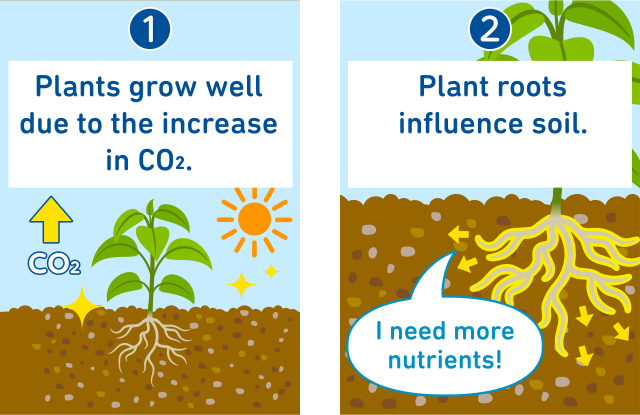
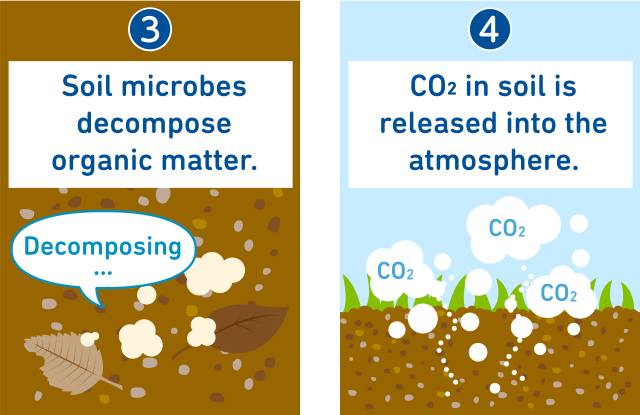
While the increase of carbon dioxide in the atmosphere does promote plant growth, the plants also require more nutrients and water to support their growth. To meet this requirement, plants release material from their roots that feeds soil microbes, which in turn produce more nutrients for the plants to absorb. When this happens, soil microbes become more active, breaking down organic matter such as fallen leaves and releasing nutrients such as nitrogen and phosphorus that the plants need. However, not all of the excess carbon contained in organic matter is stored in the soil, but returns to the atmosphere as carbon dioxide. This is the reason that the amount of carbon stored in the soil (carbon storage) decreases.
What happens when carbon dioxide (CO2) increases in the atmosphere

The quality and quantity of organic matter in the soil are also related to the soil’s ability to store water and nutrients. When carbon decreases, the soil is weakened, slowing plant growth over time.
The relationship between plant growth and soil quality had been studied before; however, Professor Jackson’s study was significantly larger in scale than ever before, and it took place in many countries. The results were a great achievement.